 )}
Japan's trains are fast between the big cities, but the volcanoes of Kyushu, the villages of the Alps, the open roads of Hokkaido and the coast of Izu are far easier by car. Take the train between regions, pick up a car where the road trip starts, drive the loop and return the car there. Each route below has a map, the drive for every day and the best time to go.
5 routes, each a loop by car
Kyushu road trip from Fukuoka
Volcanoes and hot springs on Japan's southern main island: Nagasaki, the ferry from Shimabara to Kumamoto, the caldera of Mount Aso, the onsen village of Kurokawa and the hot spring towns of Yufuin and Beppu.
Best time: March to May and October to November. Car hire at Fukuoka Airport from €489 a week.
Japanese Alps road trip from Nagoya
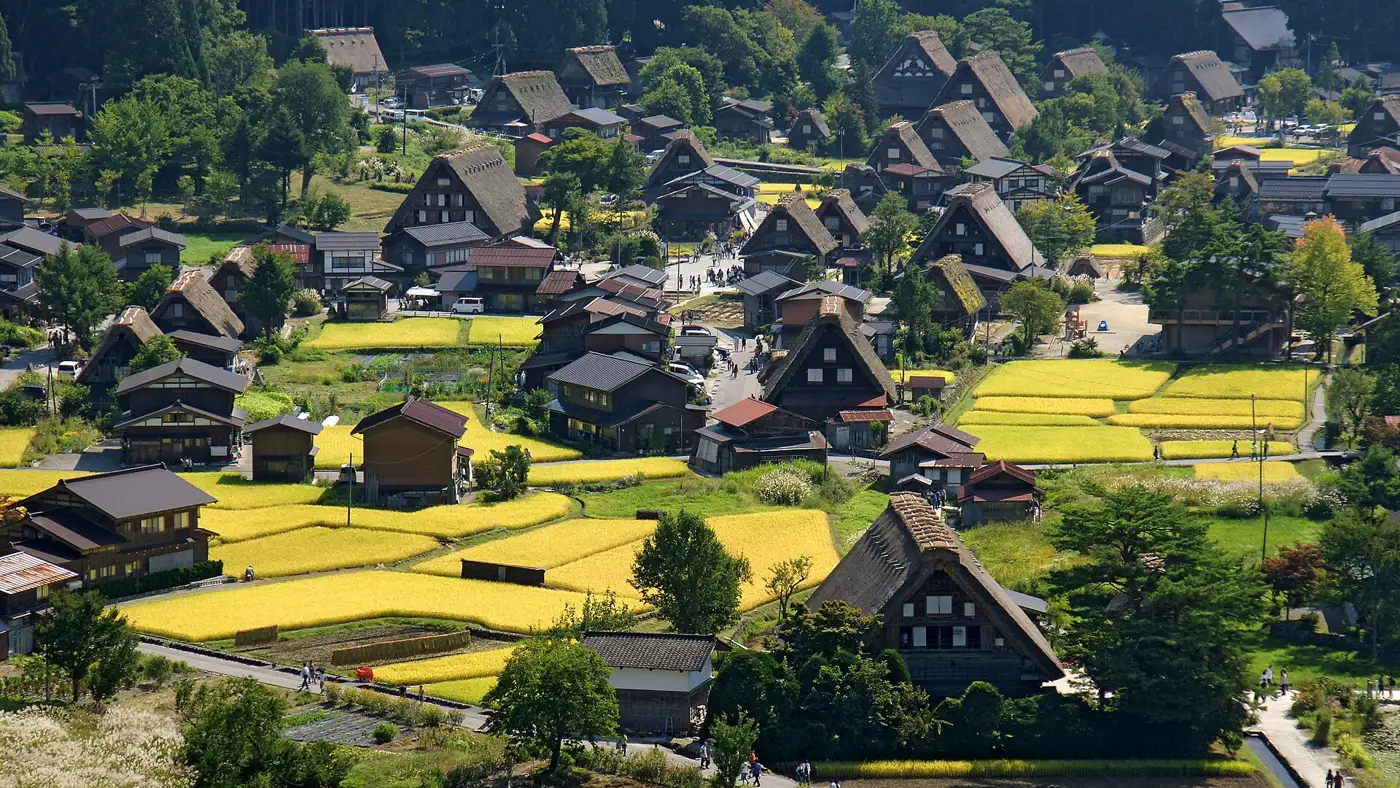
Thatched villages, old towns and mountain roads: Gujo Hachiman, Shirakawa-go and Takayama, over the Alps to Matsumoto Castle, and back along the Nakasendo through Narai, Tsumago and Magome.
Best time: April to May and October to November. Car hire in Nagoya from €548 a week.
Hokkaido road trip from New Chitose Airport
Lakes, volcanoes and flower fields in Japan's open north: hot springs at Noboribetsu, Lake Toya and Niseko, the canal of Otaru, the lavender of Furano and Biei, and the gorge of Sounkyo.
Best time: June to September. Car hire at New Chitose Airport from €548 a week.
Fuji, Hakone and Izu road trip from Tokyo
A short loop from Tokyo: the Great Buddha of Kamakura, a night in the hot springs of Hakone, the coast of the Izu Peninsula and the classic view of Mount Fuji from Lake Kawaguchiko.
Best time: November to April. Car hire at Haneda Airport from €461 a week.
Shimanami Kaido and Shikoku road trip from Hiroshima
Island-hopping by car across the Seto Inland Sea: the old towns of Takehara and Onomichi, the bridges and temples of the Shimanami Kaido, the castle and hot springs of Matsuyama, and the car ferry back to Hiroshima.
Best time: March to May and October to November. Car hire in Hiroshima from €548 a week.
How to plan a road trip in Japan
Train between regions, car within them
The shinkansen is the quickest way between Tokyo, Nagoya, Osaka, Hiroshima and Fukuoka. Use it for the long distances, and hire a car where the countryside begins. That way you avoid the expensive parking and busy urban expressways of the big cities.
Return the car where you picked it up
Every route here starts and ends at the same place. You collect the car, drive the loop and return it before you travel on, so you do not have to plan around a different drop-off point.
Plan 100 to 150 km a day
Speed limits in Japan are low, and mountain roads and stops take time. On the routes below most days have one and a half to two and a half hours of driving, with time for onsen, temples and viewpoints. The rules of the road, from your licence to tolls, are under Driving in Japan.
Expressway passes for visitors
In Kyushu, Hokkaido and other regions, flat-rate expressway passes for visitors can save a lot on tolls. They work with an ETC card from the rental desk; ask the desk which pass fits your route.
Frequently asked questions
Is Japan good for a road trip?
Yes. Roads are well maintained, drivers are careful and signs on the main roads are also in English. A car takes you to onsen villages, volcanoes and coasts that trains and buses reach slowly or not at all.
Which driving licence do I need for a road trip in Japan?
Your own licence plus either an International Driving Permit under the 1949 Geneva Convention or, for licences from Belgium, France, Germany, Monaco, Switzerland and Taiwan, an official Japanese translation from JAF.
How many days do I need for a road trip in Japan?
Four days are enough for Fuji, Hakone and Izu and five for the Shimanami Kaido; Kyushu, the Japanese Alps and Hokkaido each take six to seven days.
Can I take a hire car on a ferry in Japan?
Yes, the rental conditions permit ferry crossings; you pay the fare at the port. The Kyushu route uses the car ferry from Shimabara to Kumamoto, and the Shimanami Kaido route the ferry from Matsuyama to Hiroshima.